10 Tech Tools for Faith Formation
 Recently I was privileged to attend a workshop organized by the Institute for Christian Formation & Leadership at Virginia Theological Seminary. “E-formation Learning Exchange” was a two day event for Christian leaders (both professional and volunteer) organized with the objective of exchanging and expanding “knowledge of and confidence in technology to nuture spiritual formation, learning to engage a world in continual change.” So many new ideas and cool websites! I’ll write about becoming a Faith Formation Curator in another post, but in the meantime, here are a few free tech tools to test drive:
1. Find activities and ideas for faith formation at Curating Faith Formation , one of several websites offering a wide variety of resource links grouped either by age or formation area. Take a look, for example, under Adult Faith Formation, at Spirituality & Prayer or Justice & Service.
2. Publish a website with Weebly! I actually learned about Weebly last year when my daughter published a website for her music studio. I have used Weebly myself to create a central clearing house for school library databases and a personal online writing portfolio. Lots of templates to choose from and easy-to-follow, intuitive directions. Basic account is FREE. (You can pay to add bells & whistles later if you choose.)
4. Keep up with your To-Do lists with Astrid. You can make and share all kinds on lists on this site. One conference attendee said he uses Astrid to clear email: as he checks his email each morning he forwards the ones requiring an action to Astrid and uses those to make his daily To-Do list.
5. Another option for clearing out that pesky email inbox is Google Reader. I subscribe to several blogs, with posts which typically either serve as a distraction to my scheduled work or as clutter in my inbox until I delete them unread. If you send your blogs to Google Reader, however, new blog posts will all show up there rather than your inbox. Then all you have to do is use a coffee break to read through the various posts at one time.
6. Publish gorgeous email newsletters with Mailchimp. Like Weebly, there’s lots of polished templates to choose from (or create your own). Mailchimp offers a wide range of tutorials and training info on various ways to utilize their programs. The basic subscription is FREE.
7. Need really nice, really free images for your Mailchimp newsletter and Weebly website? Try stock.xchng. Check the fine print but most of the images are FREE for nonprofit use.
8. OK, this one is just for fun. If this then that lets you set up all sorts of “recipes” for actions you would like to see happen. Want a reminder to tell you when you need to wear a jacket to work? Remind employees to turn in time cards? Find your lost phone? Have all sorts of quirky things happen automatically? Try browsing the existing combinations in ifttt.com!
9. With all this emphasis on social media, how about a lesson plan for Facebook? Here is a thoughtful introduction for young adults on using social media from the Holy Geek Be sure to also check out the Shirtless Dancing Guy while you are there–great visual lesson on leadership!
10. And (finally), this is just the beginning! Check out the E-formation tumblr site, where you can find all these and many more links!
What’s your favorite faith formation website? What’s your best tech tool? There are a multitude of new ways to connect, engage, involve, and reach our communities. How will you build your church’s network?
Stone Soup
 Do you remember the story of stone soup?
There are many variations on the plot, but the main idea goes something like this:
A traveler stops for the evening at a village. When the villagers are unable (or unwilling) to offer a meal to the hungry traveler, the traveler offers to make stone soup. Filling a pot with water, he places a stone in the pot, lights a fire, and watches the water boil. The villagers stop by, one by one, curious about this odd dish. The traveler tells each disbelieving person how wonderful the soup will be when it is finished, but also then says: “It’s just a shame we don’t have a little bit of carrot (or potato or onion or meat), because stone soup is SO much better with that.”
To which the villager also replies: “But I have a little bit of carrot (or potato or onion or meat)! Here it is–add this to the stone soup!”
By the end of the story, of course, a wonderful soup has been prepared, a soup not just based on a stone and boiling water but carrot and potato and onion and meat…
And all eat and are well satisfied.
It is a story of generosity amidst scarcity, the synergy of shared resources. I think we’ve been experiencing that firsthand lately at the Chapel Center. In recent weeks we have seen:
- Parishioners from a neighboring parish brought a chipper shredder over and worked to clear a load of tree limbs and debris.
- A group of parishioners from the same parish banded together to buy a new television for the Center.
- The parents of one of our renters spent a Saturday working at the Center, creating a rather amazing new landscaping around our entrance.
- Another renter’s grandfather persisted in his efforts to resolve a long standing plumbing issue. (And, yes, the hot water now finally works in that shower!)
- Cupboards and closets are gradually being emptied and cleaned in an ongoing effort to make a comfortable living space for all residents.
- Our work list keeps growing but every time I add something to the list I find someone who says: “I can help with that–just let me know when.”
We had our first movie night at the Chapel Center a few weeks ago and watched “Babette’s Feast.” (If you have not yet seen it, you must. If you saw it years ago, watch it again.) In the story, Babette wins a fortune through the lottery but chooses to use it all to prepare a meal for the villagers in the town where she had found sanctuary during the war. When she offers to cook the dinner, her employers do not realize that she is a world renown chef. Indeed, those partaking the meal (which is a metaphor for the Eucharist) do not fully understand what an amazing gift they are being given.
Like those simple villagers, I’m not sure that we always understand the gift we are given in the Eucharist. But we take, eat, and are blessed. And when the Spirit uses the carrots, potatos, onions, and bits of meat we bring to make stone soup into a meal, we take, eat, and are well blessed.
Amen & amen.
Rolling in the Deep: Dialogue about Gender and God
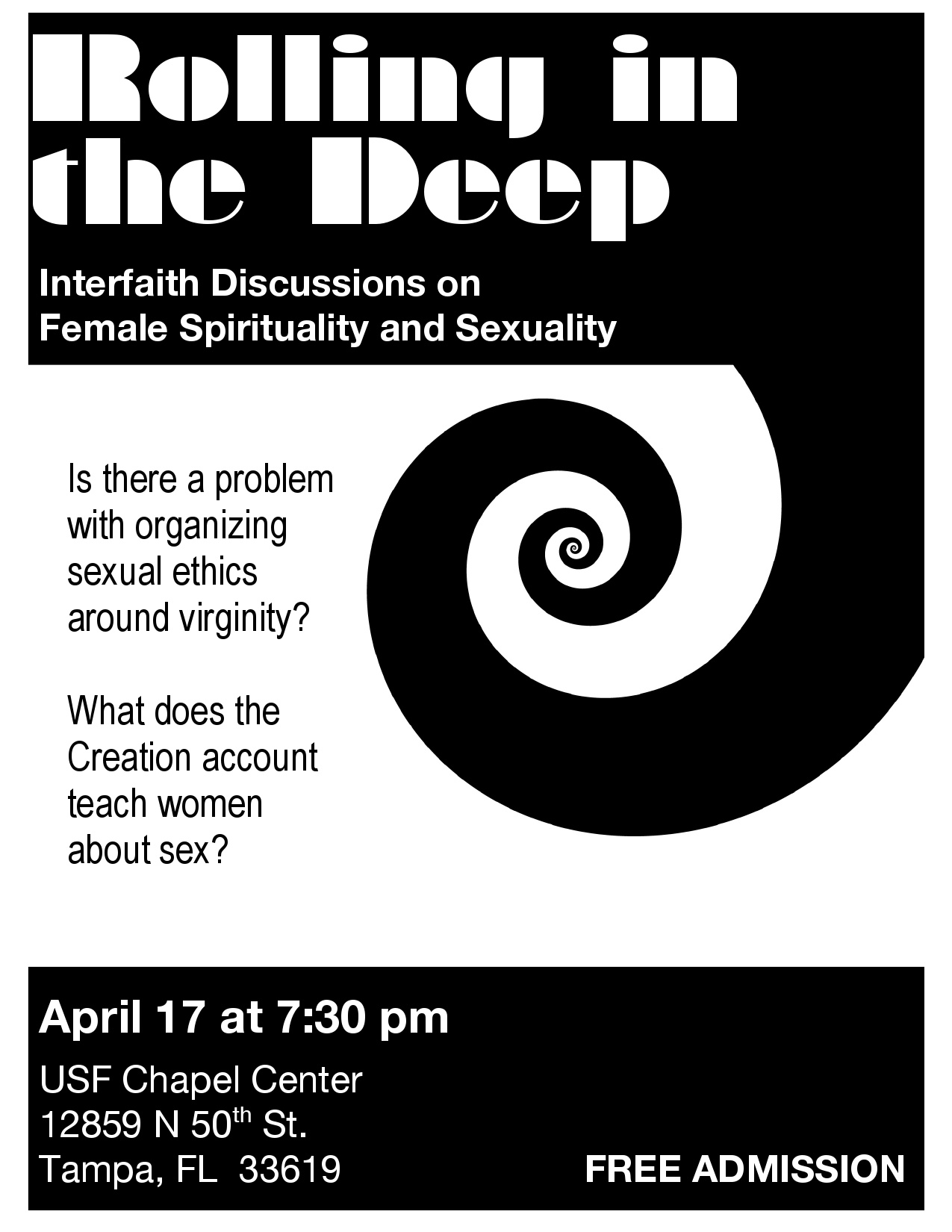 Cristin Cotton, USF communications major and Chapel Center resident, recently organized a panel discussion event at St Anselm’s as a directed studies project. “Rolling in the Deep” was designed as a dialogue on issues of female spirituality and sexuality. Over 50 students and community residents attended the event, validating Cristin’s premise that this was indeed a topic worthy of study and discussion. The following is the paper she submitted for class detailing her experience organizing the event and lessons gleaned from her research and the evening’s conversation.
Gender and God
by Cristin Cotton
“You can’t wear that dress on your date. It doesn’t show enough cleavage,” my roommate Kelly said between mouthfuls of Oreo cookies.
Kelly Davis was one of three roommates I had last year. It was while living in that dorm with those three girls that I experienced firsthand the blinding power of sexism and its effects on the shaping of female identities. My roommates were all smart with GPAs ranging in the 3.8 zone, and they were all beautiful, that is, according to Cosmos and Glamour standards. The problem, though, was that each one of my roommates equated their worth with the affirmation bestowed upon them by the various men in their lives.
I tried various times to burst their pre-conceived ideologies regarding female behavior. I can still remember the time I showed them the documentary “Killing Me Softly,” a movie illuminating distorted media portrayals of women and the violence it does to females in shaping their identity. I had wanted them to jump up and down, scream, fist pump feminism, and go burn their push up bras. None of that happened. In fact, the four of us went to Olive Garden where the conversation continued to revolve around appearance, sex, and being subservient to their boyfriends.
It was after that year of feeling like I was living in a reality TV show—where all the girls in Cypress A become Victoria Secret robots—that I became dedicated to connecting spirituality and sexuality in sustainable and meaningful ways in order to revision female fullness in accordance with God, and God’s ways.
Last spring I lived with three girls who considered Cosmo their Bible. This spring, I held a panel discussion on female spirituality and sexuality in hopes that young women know another Bible, the real one, where God speaks life into authentic female fullness, complete with sexual wholeness. Furthermore, I hoped my panel discussion would provide young women with the firm idea that it is okay to care about their bodies, looks, and sexuality; in fact, crucial. Though, by caring, may they need not fall into finding exclusive value in their appearance and male attention, and, instead see their bodies as good and therefore, requiring good stewardship.
I began putting my panel discussion together in March. I knew the topic would cover female spirituality and sexuality. I knew I wanted the panel to be open to everyone on and off campus, and, as such, I felt the topic needed wide-ranging religious worldviews. I decided to have the speakers span across religions, and I proceeded to contact a Catholic Priest, a Jewish Rabbi, and an Episcopal female priest from St. Mary’s House of Prayer. Each declined for various reasons. However, I was not about to give up.
By now I had discovered through a variety of conversations with older women as well as with my contemporaries that the subject is rarely broached. Furthermore, I became keenly aware of intergenerational female experiences that contained a lifetime of examples where women felt silenced, devalued, and marginalized as a result of pressure exerted mostly by male church leaders, past and present. One older woman at a book study I lead on Tuesday night said she had a problem with female spiritual leadership and didn’t think women could do as good of a job as a man in leading a congregation. A twenty-two year old in my Christian Ethics class said she found her purpose in being a wife and having babies and that she plans on being a stay-at-home mom after college. In that same class, a young male said he would be offended if his wife made more money than him. My own boyfriend, who has been of upmost support throughout this project (i.e., he did create the flier for my panel) emitted a resounding no when I asked him if he would get a vasectomy instead of me having to take the pill. He followed his guttural response with, “That wouldn’t be natural. It’s natural for you to be a mother; therefore you should be the one responsible for birth issues”. I wasn’t exactly offended by his comment; however, my conversation with him as well as the others fueled my drive in hosting the panel. I knew I was going to discuss this subject in one way or another.
Instead of becoming disheartened by the previous speakers’ unavailability, I was simply ready to expand on my idea. Considering the topic was, after all, female spirituality and sexuality I thought it would be meaningful to have females from various religious backgrounds speak. I went to work contacting Susan Lattimer, an Episcopal priest at St. Catherine’s, Anat Valdman, the director of Jewish programs at USF, and Sharon Mucci, a practicing Catholic female. All but Ms. Mucci said yes. Fortunately, the same day that Ms. Mucci declined, Leslie Tod, my academic advisor at USF, told me she and her friend, Geri Carter—a Presbyterian Sex Therapist, were planning on attending my panel. I immediately asked Ms. Tod if I could invite Ms. Carter to serve on my panel. Ms. Tod said of course and I went to work forming an email to the Presbyterian Sex Therapist. She gave me the thumbs up and less than twenty-four hours later I had a full panel of speakers.
The two weeks before my panel were two powerful weeks in the development of my own spiritual and sexual identity. In preparation for the big night, each female speaker wanted a list of questions that I was planning on asking. I sent them my list and expected them to prepare on their own and simply show up with hearty, profound answers. I was wrong. Each woman had questions about my questions and, as a result, I became immersed in a two week dialogue over religious rhetoric on sexual views, actual sex, cultural patriarchy, sexism in the Bible, and deceptive Victoria Secret advertisements. Moreover, during those two weeks I was also advertising for the event I titled, “Rolling in the Deep” and, as such, women’s personal stories about their spirituality and sexuality came out of the woodwork.
It might have been during my third phone call with Susan Lattimer, previous to April 17th, in which she observed, “Cristin, it sounds like you want to point out how patriarchal interpretation of scripture affects the female religious experience and how, in turn, that affects a female’s sexuality. Is that right?”
I responded, “Yes, Reverend Lattimer. That is right.”
On April 17th at 7:30 the USF Episcopal Center hosted over fifty audience members for “Rolling the Deep: Interfaith Dialogue on Female Spirituality and Sexuality.”
The questions I formed were gleaned from my reading as well as conversations with peers and, surprising to me—my mom. Dialoging with my mother throughout this process was one of most meaningful gifts this project provided. Hearing her personal experiences in regards to spirituality and sexuality put my own standpoint into perspective and it brought my experience into a wholeness that wouldn’t have been possible if it weren’t for her openness, mercy, and support.
While each question is different, they each share in the reality of being difficult to answer. I asked the questions in the order below in hopes of creating a funnel, the end point being that of grace. The first two questions pertain to scripture and how religious patriarchy interprets the female experience for them as well as without them. The following questions dive into sex both in and out of marriage. The last question—is also about grace and the role it plays in regards to sexual desire.
Below is the set of questions with my personal commentary on them as an exploration of the subject matter.
Question # 1: What does the Creation account teach woman about their bodies? About sex? Why has it been disempowering to women traditionally?
An even deeper question underlying the first would be “How has a patriarchal interpretation of the Creation story languaged female sexuality?” When answering the latter, it becomes undeniably clear that the main points of the Creation story preached to females (by men) are: The man is made first and the woman second. The woman is created for the sake of the man; she a helpmate to cure loneliness. The woman comes out of man and is made from his rib. The man names the woman. It is the woman who falls victim to sin and eats the fruit and, in turn, causes Adam to sin as well. God punishes the woman and says that she will desire her husband and he will rule over her. Lastly, God prescribes pain for her in childbirth.
This recurring narration of the Creation account is disempowering to women. First, the rib is often related to female inferiority and subordination. Moreover, it is suggested, almost mandated, that by Adam naming the woman, the male has power and authority over the female. In addition, patriarchal perversions of Eve’s sin twist the story into depicting women as weak insofar that they are allured and tempted more easily than man. To make a bleak picture even darker, women are taught that their bodies are bad, objects of sin, and, as such, they are warned to cover up as too not make their brother fall.
Feminist author Mary Daly, in her book Beyond God the Father, suggests that the creation story, in which Adam names the animals and woman, is the paradigm of false naming in Western Culture (8). Sue Monk Kidd, in The Dance of Dissident Daughter, echoes Daly, “For eons women have accepted male naming as a given, especially in the spiritual realm. The fact is, for a long time now, men have been naming the world, God, sacred reality, and even women from their perspective” (38).
Both Daly’s and Kidd’s comments provoked me to look deeper into the silencing of women. Throughout my reading it became clear to me that women’s voices are missing in symbol-making circles. Even with more women becoming doctors, lawyers and even CEOs, there still lacks a significant presence of the female voice within religion. The answer may lie, as the question suggests, in the fact that historically the Eve’s of the world have been silenced and placed in oppressive situation where their agency is unable to blossom. Jungian analyst Sylvia Perera writes, “What has been valued in the west in women has too often been defined only in relation to the masculine; the good, nurturing mother and wife; the sweet, docile agreeable daughter; the gently supportive or bright achieving partner” (12).
I found this to be particularity true in the church. Women reign in nurseries and social meeting halls but are absent from the pulpit and settings where theology, policy, and spiritual meaning are forged. As a result, women in church coordinate church dinners, arrange the flowers, sweep the floor, look pretty, and are expected to be supportive. In other words, women have frequently functioned, “more as church handmaids than religious symbols creators” (Kidd 53).
Where do women go from here? I began to wonder. Author Sue Monk Kidd left the church because she found that the answer lies in leaving the institution completely. She felt that her true self was suffocated in relation to religion and the only way for her to come into fullness was to get out from under, what she saw to be, an oppressive “Boys Club.”
Although I found Kidd an invigorating read, I believed there were ways to stay within religion without falling victim to its patriarchal standards. In fact, I found that my personal relationship with God provided even more meaning, and certainly perspective, in the shaping of my identity. Yes, I recognized the seemingly endless amounts of “Texts of Terror”, to borrow from a Trible title, but that there was also a handful of scriptures voicing mutuality, equality, and wholeness. For example, the verse in Galatians, “There is neither Jew nor Greek, there is neither bond nor free, there is neither male nor female: for ye are all one in Christ Jesus” (3:28); I found this to be religious and spiritual wholeness in its fullness.
Moreover, I saw feminist theologian Elizabeth Johnson’s book She Who Is as a beautiful rendition of female empowerment within religion. In a section of her book titled “Experience of Self, Experience of God,” she writes, “A central resource for naming toward God, the very matrix that energizes it, is the breakthrough of power occurring in women’s struggle to reject the sexism of inherited constructions of female identity and risk new interpretations that affirm their human worth” (62). This foundational experience, according to Johnson, can be explored through the lens of conversion: the transformation of mind and heart that sets life in a new direction.
Johnson is suggesting that women’s awakening to their own human worth can be interpreted as conversion insofar that they begin to see, think, and act in accordance with their authentic self, that is, imago Dei. This conversion, moreover, brings with it a “…concomitant judgment about the positive moral value of female bodiliness, love of connectedness, and other characteristics that mark the historical lives of women in a specific way” (62), so that speech about the mystery of God is given new shape.
In light of the question previously posed—that is, a female’s conflict in forming her identity in relation to oppressive scriptures—I saw a sustainable foundation for female empowerment within Johnson’s empowering paradigm insofar as the female religious conversion happens when the woman turns away from things that diminish, distort, and deny her a life of fullness in God. Could Johnson be suggesting that it is okay, even crucial to a female’s religious identity, to turn away from oppressive scriptures? Arguably yes. I saw Johnson to be encouraging women to say no to sexism in all its capacities and yes to the integrity of women.
Question # 2 Casual sex, is there such a thing? How does culture’s perversion of sex hurt females’ shaping of identities?
The answers to such a question are painfully difficult to form, especially when juxtaposed to popular culture’s portrayal of casual sex. Take for example, the new show airing on HBO titled Girls. The show not only romanticizes casual sex by leaving out emotional consequences but also associates casual sex with female empowerment and choice. This poses an immediate and obvious conflict for females trying to reconcile their spirituality and sexuality. Still, casual sex is deceptively freeing insofar that the act of sex demands a “casting off” of insecurities and personal boundaries. There is a significant difference, though, between the artificial empowerment the girls on Girls find and authentic empowerment found in a personal relationship with God.
Real sex, that is, sex sanctioned by God within a marriage, is narrated as a unifying experience where each individual feels safe, secure, and comfortable with themselves as well as with each other. Arguably, those same feelings are possible in casual sex as well. But casual sex is a contradiction in terms. Sex—even sex that does not feel intense or meaningful, even sex with someone you don’t love—is never truly casual.
To understand that sex can never be casual and therefore never identified with spiritual empowerment as understood in God, women must understand what sex really is. Consider 1 Corinthians 6:15-17 in which Paul tells the Corinthians to avoid prostitution. Underlying Paul’s instruction to avoid fornication, there is a positive view of sexual intercourse insofar that it involves two people in a life-union; it is a life-uniting act. It may seem casual, but in fact, it is always profound. Regardless of how two people view sex, the act is uniting in the creation of “one flesh.” Lauren Winner, author of Real Sex, comments that in the act of perceived casual sex, “your body makes a promise whether you do or not” (88).
Furthermore, sex, as sanctioned by God through marriage, stands at the intersection of nature and grace. The bodily experience might say, for example, that sex feels good, that nerve endings have been stimulated, and it feels good emotionally being held. But that kind of sex must be read as a limited experience of a fallen person—and, when sex is rightly ordered by the honor given it by a Godly marriage, it changes into a full experience of nature infused by grace. Therefore, casual sex is grossly insufficient. And it is in its insufficiency that deems it an inadequate model for religious female empowerment.
Question # 3: Can sex be separated from procreation?
Another problem with casual sex is that it toys with the idea that sex can be wholly separated from procreation. Christian tradition teaches sex as unitive, procreative, and sacramental. The unitive aspect is hinted at in Genesis 2:23 when Adam says that Eve is “bone of my bone and flesh of my flesh.” The procreative link is also highlighted in Genesis when God commands his people to be fruitful and multiply. The sacramental part of sex is implied in Ephesians 5:32, when Paul, having offered a set of guidelines for how husbands and wives should relate to one another, says, “This is a profound mystery—but I am talking about Christ and the church.” Paul is explaining that marriage, as well as marital sex, is meant to reenact the covenant that God makes with us and that we make to one another in the marriage vow.
Openness to children reconfigures how a couple experiences and understands sex. Winner suggests that sex without the possibility of procreation “quickly becomes part of a romantic two-ness, wherein the couple simply becomes more and more deeply interested in another” (66). She continues by saying, “The prospect of procreation reconfigures unity, forcing the couple out of themselves, out of a potentially suffocating and selfish oneness, toward another” (66). With Winner’s thoughts on procreation, along with the previous analysis of casual sex, it is possible to affirm the connection between procreation and sex without stepping over into a Roman Catholic position in that the whole of a couple’s sex life should be open to procreation, but each and every sex act doesn’t have to be. Moreover, it is possible to be concerned with the misuse of contraception out of wedlock insofar that it does violence to what sex is ultimately about, an act made meaningful in relation to the marriage covenant as sanctioned by God.
Question # 4: Is the desire to have sex a reason to get married?
This question too often receives a resounding yes from Church culture. Popular religious discourse states that the reasons for delaying a marriage, i.e., wanting to know ourselves, establishing some savings, finishing college, or graduate school, are impulses that speak to a distorted understanding of marriage. In agreement with this language, Lauren Winner says that, “The anxious parent who recognizes and wants her college-aged daughter to postpone marriage rightly recognizes that people change a lot on their early twenties. But what the parents fails to recognize is that there is no point at which we can be sure of ourselves” (69). Winner further supports church discourse by agreeing that there is no age at which we truly know ourselves, and “there is no length of courtship after which we really know our sweeties” (70).
While I saw the truth behind Winner points, I was and still am hesitant to jump on her bandwagon. The section in Winner’s book where she discusses Paul’s words, “It is better to marry than to burn with passion”—I feel, leaves out multiple hard truths about marriage. For one, women who grow up being shaped within patriarchal society become disillusioned when their husband fails at mirroring the chivalrous prince charming marketed to them by the church as well as society. Both Winner and the church fail at providing a platform for the female perspective to come to voice on the topic of marriage. Conversations within women’s groups, female Bible studies—these do not count because they take place outside dominant culture, at the margins, and are not wholly accepted for the dominant public conversation.
Sexual desire is profoundly important within the marriage. But is it a reason to get married? I say no because I don’t see its sustainable link within a Christian marriage, not when there are so many larger factors contributing to a healthy mutual marriage. Shared sexual desire between two people does not showcase long-term honoring of one another, respect for each other, pivotal valuing of one another, a couple’s team spirit, one person’s listening skills, etc., the list goes on. In fact, marriage in the past has reflected an oppressive construct to female identity. For instance, As Carol Christ, in her introduction to Woman Spirit Rising, points out,
If marriage has always included the notion of female subordination, then perhaps marriage is not the only or the best way to organize sexuality and the rearing of children. If the great works of Western literacy and philosophical tradition view women as less than fully human, then perhaps those great works do not reflect the highest human values. And, if the Bible and religious tradition teach sexism, then perhaps those traditions are not inspired by God in the ways their adherents claim (7).
Christ’s words shed immense truth upon rhetoric of sexual desire within a marriage in that it showcases how marriage has been, more often than not, a place of female subordination as taught by the Church. Until women begin to see clearly the ways in which they have been silenced, sexual desire—while an important aspect—is certainly not worth a female ordering her life around.
Question # 5: How does our culture’s objectification of women contribute to problems in the bedroom?
The objectification of women transforms sex into a product-oriented act. It is when magazine articles “guarantee” following their advice about how provocative moves will provide both persons with explosive orgasms that sex becomes a pathway to achieve the highest amount of pleasure. No longer is the emphasis on sex as a meaningful connective process between a couple but, now, sex’s role is a means to an end. Furthermore, the guarantees of pleasure confront larger problems when in relation to differences among individual bodies. Individual female and male bodies may not, and most likely will not, respond the way the article guarantees it will. This leads to disappointment between partners as well as a sense that something must be wrong with their bodies. When, in fact, nothing is wrong except that God created each and every one of us different, and there is certainly nothing wrong with that.
In addition, sexualized images of females are not real and only enhance males’ ideas that women are objects meant for their satisfaction. Or, females take on the belief that their ultimate purpose is fulfilled in sexually satisfying a male. Moreover, there is an overarching narration that showcases eating high calorie food as an act of sin or even an act of “giving in” to temptation. This idea rears its ugly head at events like Christmas parties, where individual women surrounding a table lavished in goodies, purse their lips and say, “I’m trying to be good this year” and proceed in avoiding the chocolate truffles.
The problem is not that advertisements reflect things of the body. The problem is that dominant media portrayals of things bodily are, more often than not, a misrepresentation of reality. This matters, because the way female bodies are perceived affects how males and female alike think about the relationship between sexuality and sex.
Question # 6: Rosemary Ruether, in her book Sexism and God Talk, states that scripture is the plumb line of truth and untruth, justice and injustice. She continues to say that scripture must also adapt to changing social contexts. How do Ruether’s thoughts apply in a conversation about female spirituality and sexuality?
I felt like Ruether struck a good balance by stating that scripture is “the plumb line for all truth,” but then following that statement by warning against viewing scripture as static. One perfect example would be verses saying women cannot be leaders in the church. For years, Church tradition took this literally and, as a result, women have been barred from religious leadership positions. Fortunately, Ruether’s second instruction has found a foothold and female spiritual leaders are becoming more accepted. While seeing a female preacher is “normal” to me, my mother, on the other hand, still reminds me that this was unheard of when she was my age. And to this day women are often relegated to peripheral roles within the Jewish and Catholic tradition.
Moreover, contraception and its ties to religion is a topic seen most recently in the news, especially within conservative political discourse. Republican presidential candidates talk of contraception as if the issue was one-dimensional. In reality, these policy makers (men making decisions regarding the female body) are behaving as if scriptures on childbirth can be wholly discussed without including a female’s biographical and cultural background. In today’s world, I feel that you cannot generalize issues surrounding female spirituality and sexuality. Like Ruether said, our scripture reading—and political policies—must adapt to changing social situations; that is, a woman’s cultural and economic background, education, class, and race must be part of the conversation.
Question # 7: How should grace be fit into a conversation about sexual desire?
I have found that too often condemnation, rather than grace, is at the forefront of any conversation about sexual desire. For instance, women are warned to not let their vanity be a man’s undoing. This framing does a disservice to a female in shaping her spiritual and sexual identity. Because the church fails in taking seriously men’s ability to not lust in the presence of loveliness, the church shames women who—whatever their other fabulous qualities—also want to be affirmed for their beauty. If every man is “fighting a battle” against lust, and if few men are capable of distinguishing appreciation for beauty from carnal longing, then every woman who dresses to be validated becomes a traitor to the cause of spiritual purity. The end result is devastating for too many.
Moreover, the church misplaces shame by equating female beauty with intentional malice or deliberate seductiveness toward men. That is, the church shames women for not being better stewards of that supposed weakness. That shame doesn’t just lead to unhealthy sexual relationships (including between husbands and wives); it leaves too many women feeling as if they’re vain, shallow temptresses.
This broken religious worldview reduces human behavior down to a predictable set of gendered, inevitable physiological responses. This shouldn’t be the framework for a Christian discussion of sexuality, desire, and the longing for affirmation. If grace is real, it is strong enough to give us the capacity to distinguish between the longing to be validated as beautiful and the longing to cause another person to be overwhelmed by a desire so strong as to make one forget their commitments. The Church needs to talks about beauty and desire in ways that frame grace in its fullness.
Reflection and Conclusion
In the beginning of this project I took it for granted that female spirituality and sexuality are rarely thoroughly discussed in unison and that even individually the topics don’t receive a lot of attention, if any at all. Too many women, young and old, confessed to me that they have never heard these topics discussed in relation to each other and certainly not out loud in public.
Personally, I am blessed to have grown up in a home where female spirituality and sexuality were not only forever linked but honored, valued, and topics of fervent discussion. My parents and I never really had a “sex talk,” at least not in the traditional way that I see sex talked about in a Christian home. My parents didn’t diagram the human body, nor did they beat around the bush with silly stork tales of pregnancy. Instead, my sister and I were invited to watch adult movies and attend adult-themed plays. We listened to smooth jazz as a family and talked about the music’s sensuality. We frequented parks, the beach, and the mountains, all the while talking about God’s beauty and majesty and equating it all with personal stewardship of the earth and our bodies, how it is all linked together.
However, while I was blessed by parents who felt it was important to provide a well-rounded worldview for both my sister and me, their way of parenting did not keep my sister and I out of “trouble” any more than a girl who had lax parents or a girl who had a sheltering lifestyle. For one, neither my sister nor I are virgins. So even I, who grew up watching sexual desire go haywire in various movies and plays, partook in sex out of marriage. But, I also have plenty of female friends whose parents sheltered them from such images and conversations who have also participated in sex out of marriage.
I don’t know if there is a right way and a wrong way in raising kids so that they don’t have sex. Perhaps the truth is it takes more than a single family’s best efforts. But I also don’t think that focusing on the “right” way is of much importance. Not when a female’s spirituality and sexuality is, first, almost never talked about it in the first place, and second, languaged by religious patriarchy.
On April 17th I wasn’t interested in making virgins out of student listeners, but rather in providing a platform for the female religious to come to voice on a topic often painted as taboo and not wholly accepted for conversation. My panel’s audience had over fifty members. Clearly, conversations about female sexuality and spirituality need to happen more often and they need to happen across religions, across cultures, across generations, and, even more importantly, they need to happen between genders.
By understanding how patriarchal interpretation of scripture affects the female religious experience, it becomes possible to deconstruct, and then explore new ways for females to articulate their understanding of sex, sexuality, and spirituality. Furthermore, to discuss and define these dynamics is of great value and importance, for only then can the wisdom and insights be shared and the difficulties worked through and solved. The questions I asked are questions of importance, and I recognize that women today can not only ask them out loud, but they can expect answers. Answers that emerge from the fresh exploration of God’s word, by gender inclusive communities in the midst of evolving church traditions.
Works Cited
Christ, Carol P., and Judith Plaskow. Womanspirit Rising: A Feminist Reader in Religion. San Francisco: HarperSanFrancisco, 1992. Print.
Daly, Mary. Beyond God the Father. Boston: Beacon, 1973. Print.
Johnson, Elizabeth A. She Who Is: The Mystery of God in Feminist Theological Discourse. New York: Crossroad, 1992. Print.
Kidd, Sue Monk. The Dance of the Dissident Daughter: A Woman’s Journey from Christian Tradition to the Sacred Feminine. [San Francisco, Calif.]: HarperSanFrancisco, 1996. Print.
Ruether, Rosemary. Motherearth and the Megamachine. New York: Seabury, 1975. Print.
Winner, LaurenW. Real Sex: The Naked Truth about Chastity. Grand Rapids: Brazos, 2005. Print.
Lessons learned for the road ahead
I attended a college co mmencement recently and sat through the usual round of graduation speeches, mostly a garden variety of idealistic “carpe diem!” and “full-speed-ahead!” charges to the new graduates.
When I graduated from college many years ago, one of the adults in my life told me, repeatedly and enthusiastically: “The world is your oyster!” I never quite understood what that meant or why it would be a good thing. I wonder if graduation speeches really mean anything to the graduates or if they just provide a bit of filler before your name is called and you get to walk across the stage?
What these particular speeches did for me was to start me thinking about this past year at the Chapel Center: what progress we have made and what lessons we have learned.
Starting with what we have done this year:
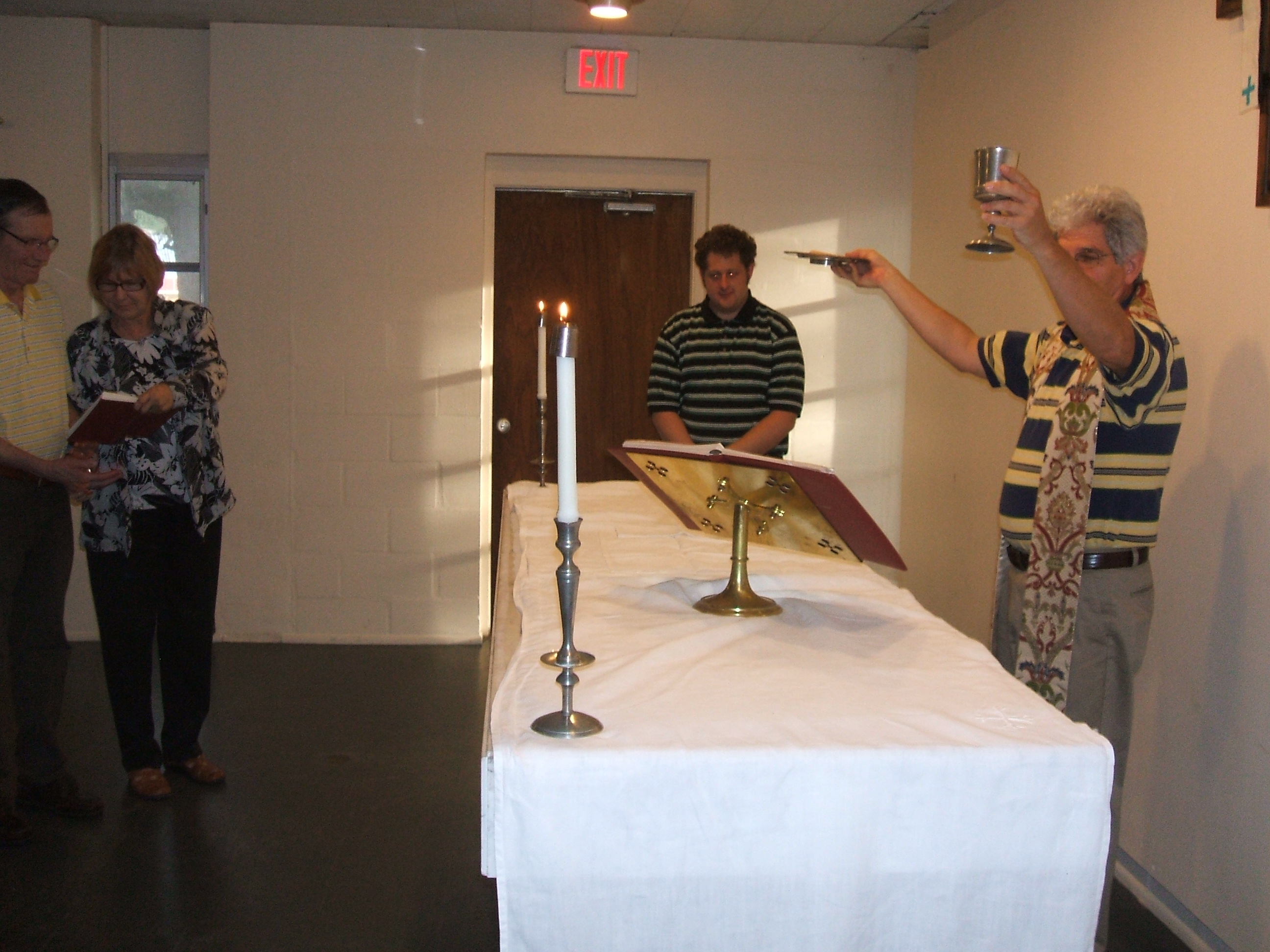 We celebrated the Eucharist together every Sunday night. The cornerstone of our community life is weekly worship. There is sometimes a bit of levity–ask anyone in our group about the “goldfish of Christ”–but worship is lively and participatory. We’ve added new songbooks this year and are experimenting with the various liturgical odds & ends excavated from our sacristy.
 We shared an evening meal together each week. We practice kitchen fellowship in cooking and cleanup. Souper Bowl chili, Shrove Sunday pancakes, and a few other favorite recipes such as “Mediterranean Medley” (the secret ingredient is cinnamon) are becoming traditions.
 We filled the Chapel Center with residents. Our single student scheduled to live in the Center last August quickly became a houseful with all four bedrooms rented. As we finish this term we have three new renters moving in to fill graduates’ spots and we now have a rapidly growing waiting list.
 We started a weekly book discussion group. We started “Dig Deeper” as a student book club but it quickly evolved into an intergenerational mix of adults from a neighboring parish and students from USF. So far we have read Rob Bell’s “Love Wins” and Joan Chittister’s “Uncommon Gratitude.” The conversation typically covers everything from Death to blueberries.
 We built a garden. Yes, I know that should be “planted a garden.” What we actually accomplished was building raised garden beds in the shape of a Jerusalem cross. (Such a cool design!) The planting and nurturing has been less successful, though we currently have some Feed-Me-Seymour-sized kale plants running amok and untended in the midst of our beds.
 We hosted a successful lecture series, panel discussion, and musical event. We learned that topics like sustainability and female spirituality&sexuality are a draw for our university community. We learned that we can talk about fairly controversial subjects fairly well.
So, what does this mean for us in the year ahead at the Chapel Center?
We need to plan for growth.
I dearly love our Sunday night gatherings but I think it would be REALLY easy to get comfortable and clique-ish with our current attendance. For example, when I recently started going meatless in my own diet, I realized that we really didn’t have a vegetarian option for the occasional visitor who is not a carnivore. And, while we comfortably feed our current crowd, shouldn’t we plan to accommodate more? Are we welcoming the newcomer who happens to drop in or does our full table seem to hang a “No Vacancy” sign on our door? I think there are 40,000 students currently enrolled at USF. We need to invite a few more in on Sunday nights.
We need to build an intentional community.
While our house has been filled with a variety of really nice students, we have maintained a sort of “Union Station”–lots of trains coming and going with everyone following his own agenda. A community needs to be, well, communal. Shared work, shared play. Learning to get along with others in the same household. We can do so much more together.
We need to be good stewards of our resources.
We need to figure out what we do well and focus. No more shotgun approach, which is sorta what we have tried this year. Like many other campus ministries, we are SO limited on staff and budget. What can we do that will be truly meaningful and useful? What will make a difference?
Also, we need to take good care of our building and grounds, knowing that they represent the physical presence of the Church on our campus. Dilapidated building and forlorn entrance? How can we welcome visitors into the house of God if the very front yard is untended and unappealing?
We need to plan carefully and follow through, holding each other accountable for the tasks we undertake.
It is easy to make plans. The tough part is putting feet on them, deciding who will do what to actually follow through on those really great ideas and how will that person be accountable to the rest of the community.
We need to look to the future and work towards long term sustainability.
The Chapel Center will celebrate its 50th anniversary later this year. The history of the Chapel Center has included times of growth and expansion but also periods of decline and inactivity. How do we get off that roller coaster?
Playing Scared
 I had a parking lot conversation the other night with another musician about his upcoming graduate recital. We were talking about practice and preparation and the conversation naturally turned to dealing with performance anxiety.
If you are a musician, at some point you are going to perform for someone other than the family dog and that can generate a tremendous amount of angst. Assuming you have prepared well (and if you are performing something that is not well prepared….well, that’s a whole different set of worries!), there is a point where you have done all you can do but still think:
I’m not sure I can do this!
This is gonna fall apart!
I will look like an idiot to EVERYONE in the audience.
The thing is is that this slippery slope leads to playing scared. That means that you don’t take chances with the music and you think that slower/softer means safer. What generally happens is that you still make those mistakes you feared PLUS the music is boring and lifeless.
What I said in that parking lot conversation is that I used to assume that a good performance was a “perfect” performance–all the notes and rhythms in the right place. What I now believe is that a good performance is authentic. It is musical. It takes some risks. It has life. Yeah, there are some screwups. But that is life too, isn’t it?
I think we play it scared in our religious practice some times, by the chances we take or not. Lots of folks have written about witnessing: taking a stand at the water cooler at work and inviting your neighbor to church. That demands that you be authentic. And that you take a few risks.
But also–and it can be scary too at times–I think you have to take some risks at church. Try something new. Speak up when you don’t understand the theology you see performed in front of you. Ask questions in that Bible study. Be honest. Just for once, don’t just smile, nod and agree. Open your mouth and say: “You know, this passage has just never made sense to me. What are we supposed to make of it?”
Afraid you will ask a stupid question? Sound silly? Well, maybe. On the other hand, you just might learn something. Your faith might be strengthened.
Peter is one of my heroes in the New Testament. I wish I were more like him. You have to cringe sometimes for him:
“Hey, Jesus! I can walk on water too! Oops, wait! No, I can’t!!”
Peter often seems to jump in before he has thought things through and say the wrong thing. But he SAYS something (probably what everyone else was thinking but afraid to put into words). I think Peter would have been a great trumpet player. Sure, he would have missed some of those high notes. But he would have gone after them and the ones he hit would have been glorious.
The musician I talked to in the parking lot was getting ready for a graduate recital and, as we all do, voiced some concerns about having things ready. Last night at his recital he was in the midst of a particularly difficult number when something seemed to go wrong. He hesitated, his pianist stopped and repeated an entrance. The soloist put his horn down and abruptly walked to the front of the stage and addressed the audience:
“A preacher was delivering a sermon on Genesis when he found his sermon pages to be out of order. He suddenly stopped in the midst of his message to say:
‘Adam! Adam!’ Eve said. ‘You seem to have a leaf missing.’
I seem to have the pages of my music out of order. Please excuse us while we start this section over.”
The audience roared with laughter at the joke and settled back to enjoy the rest of the program. A flawless evening? No, but authentic and joyful and full of life. There was a lot of music played that night.
Let us come to our faith with the same enthusiasm and lack of fear. With God’s grace, the music of our lives will likewise be authentic, joyful, and full of life.
Everything I ever needed to know I learned from a rottweiler. Really.
 I got over to the Chapel Center early this morning to meet up with an air conditioner service guy. Our AC units are working but not efficiently, and in Florida that is a serious– and inevitably costly–issue.
One of our student residents was heading out as I made my way in. I could hear some scratching and whining coming from the door to the residence area. She warned me that one of the other students was (temporarily) watching her family dog at the Center.
“It’s OK. It’s a very friendly dog.”
“What type is it?” I asked. “Big? Little?”
“Sorta big. One of those types that is supposed to be really mean. But it’s not. It’s really friendly.”
“Pit bull?” I ventured.
“Yeah, I think so. That’s it!”
“Great!” I thought, heading to the residence area. I happen to like dogs. I have two large dogs at home myself. I, however, have learned that the concept of “friendliness”–especially in meeting visitors first time–can be kinda unpredictable and a bit iffy.
I opened the hall door. It was not a pit bull. It was a rottweiler.
It was, however, a rottweiler who was indeed VERY friendly and deliriously happy to see me.
And the AC repair guy.
And our chaplain, who arrived a few minutes later.
And his owner, who arrived a bit after that.
It turned out to be a great morning. The Librarian in me loved the fact that I was able to clean out the chaplain’s office space, organize the storage closet, and pull out a buncha stuff to donate to Good Will, the Salvation Army, or anyone who would be willing to cart it away.
On the other hand, the List-maker/Organizer/Git-R-Done gal in me also was starting to freak out a bit, considering that (according to our new AC guy) we need: window tinting, new awnings, a bunch of good quality vertical blinds, and just maybe some trees added to our landscaping to make the Chapel Center energy efficient and comfortable.
Ka-ching….
Add that to new exterior doors, plumbing repairs, new furniture in the study area.
And wouldn’t it be nice to finally have something up on the walls too and just a little decorative details to “warm up” the place?
How about something as simple as fixing the damper pedal on the piano in the Chapel Center, which doesn’t work in spite of the fact that we now have new songbooks and we’d actually like to sing on Sunday nights?
It’s easy to start seeing a price tag on everything–either for replacement or repair. At this time of the year, with graduation rapidly approaching, it is especially frustrating to measure what you hoped to accomplish against the realization that there is still so very much left to do with little time and no money.
However, perhaps that rottweiler has got it right. (My German shepherd and Golden retriever at home have the same philosophy):
Life is an amazing journey.
People are infinitely entertaining.
Enthusiasm is the best gift we can offer.
We will get where we need to be eventually. It will all be OK.
Wag more, bark less, right?
Really. What more could anyone want?
Dig Deeper: Waiting for the Bus
 “What is the most surprising way Jesus has shown up in your life?”
That question was the start of our most interesting conversation yet last week in our book discussion group. We’ve been talking about Rob Bell’s “Love Wins” and his views on heaven and hell. It’s been a great book for discussion but we are nearly at the final chapter and I for one am beginning to feel like we’ve said all we can say on the subject. Time to move on. After all, when we talk about the afterlife, at some point we are speculating. As one of our members said: “We really just don’t know, won’t know until we get there.”
You may agree or disagree with Rob Bell but you can’t prove or disprove what he is saying. (And most of our group tends to fall in Rob’s camp, so there’s not much for us to argue about amongst ourselves….)
However, this week we were talking about Jesus as our Rock and the group was asked where and how Jesus has shown up for them in this life. For some members of the group, Jesus had surprised them with a sense of peace and calm at times of great personal tragedy. For others, the stories were less dramatic but his presence no less sure and certain.
For me, Jesus has shown up in surprising ways through people around me. Sometimes it has been that person who stops long enough to really see me, really listen to me, when I need help. And sometimes it is that person who gives me the word I need to hear, the word that makes me realize I need to get up and move. Time to stop waiting for the bus.
I remember an incident that happened to my daughter when she was traveling to a graduate school audition. On this particular trip, she ended up going by herself to a strange city. She did really well, negotiating the airport, catching a bus to her hotel, getting to the various appointments at the university. Finally, on Saturday morning she checked out of the hotel and went to the bus stop to catch the bus back to the airport for her flight home.
But the bus didn’t come.
She waited and waited, increasingly anxious about getting to her plane on time. Finally, a strange looking young woman with rather wild hair approached her and asked: “Are you waiting for the #35 bus to the airport?”
My daughter said she was.
“Well, that bus doesn’t run on the weekends. You need to cross the street and go up two blocks. Wait on the opposite corner. The bus that comes that way will get you to the airport.”
She did and it did.
When my daughter told me this story, my first reaction was that she had indeed encountered the divine. (An angel, perhaps? Not a scary New Testament Gabriel sort, but to a young girl sitting alone on a deserted city street, just as unsettling and awesome.)
Rob Bell says our belief about the afterlife–our eschatology–affects how we live our lives here. Perhaps it is the other way around. I may not know with certainty what heaven will be like but if I know the sure and certain presence of a loving God in the Here and Now, how can I do otherwise than believe that I will be with that loving God in the Yet to Come?
Wishing us all a blessed Lenten season ahead on this Ash Wednesday evening….
Here is the NewThere
This week our reading assignment for Dig Deeper was, quite simply enough, chapter 1 and 2. We had pretty much talked about the introductory chapter in our first meeting last week, so my attention was focused on the second chapter: “Here is the New There” or Heaven.
(Spoiler alert–next week we get to talk about Hell.)
Much of the introduction to this chapter discusses our images of Heaven, and during this past week I have been obsessed with how we view Heaven, not in traditional artistic rendering but, much closer to home, in movies and television. I wracked my brain for movie imagery and I suppose I thought I might be able to bring something rather profound to our group. Instead, my Youtube search only yielded:
- “Heaven Can Wait”: A youthful Warren Beatty wandering through the clouds.
- “Defending Your Life”: If you don’t get it right the first time around, you go back and try again.
- “Field of Dreams”: The meaning of life is…..baseball. (“Is this heaven? No, it’s Iowa.”)
- “Dogma”: Ben Afflect & Matt Damon play two angels, banned from Heaven for excessive smiting, who find a loophole which will allow them to bypass God’s judgment and get them back in the door.
- “What Dreams May Come”: Robin Williams dies and goes to a fantastically beautiful heaven, frolics a bit with his dog and Cuba Gooding, but ultimately makes the choice to go to hell to save his wife.
- “Ghost”: When you die, if you have loose ends to take care of, you get to hang around until you wrap those up. Then, if you are a good person, you get to go toward the light. (If not, you get dragged down to Hell by the scary black shadow-things……but that’s next week’s chapter.)
- Actually, “Sixth Sense,” “The Lovely Bones,” and every episode of TV’s “Ghost Whisperer” are based on the premise that you get to settle your accounts, so to speak, before you “cross over.” And, of course, you still might need someone to tell you to cross over….
As Rob Bell points out in this chapter, our images of heaven usually refer to crossing over to something or somewhere “other.” And what will our existence be like in that other realm? In film, heaven usually can wait, because life on earth–our relationships, our work, our passion–seems so much more real than white robes, harps, and clouds. What Bell describes as heaven in this chapter is not a far away distant place, but heaven on earth–earth restored to the state where things are as God intends them to be and where man is ultimately recreated and existing in Eden’s partnership with God.
This is a future that starts today with everything we do in this life to bring in the kingdom of heaven. Not a life spent watching and waiting for a better world to come but a life in which we “move toward the light” as we grow, experiencing more and more heaven day by day in the here and now. And while we are working for the kingdom, God is at work on our hearts, making us ready for that new citizenship.
As Bell puts it:
“Our eschatology shapes our ethics.
Eschatology is about last things.
Ethics are about how you live.
What you believe about the future shates, informs, and determines how you live now.” (p. 46)
This heaven is not less real but more real, and those moments in life marked by “intensity of experience that transcends time” are just a foretaste of the life in heaven to come.
We may be “watching and waiting”, but we also have work to do here.
As another author has written: “Ours is not the task of fixing the entire world at once, but of stretching out to mend the part of the world that is within our reach. Any small, calm thing that one soul can do to help another soul, to assist in some portion of this poor suffering world, will help immensely. It is not given to us to know which acts or by whom will cause the critical mass to tip toward an enduring good.” (C.P.Estes, 2003)
And I rather like that thought….
Dig Deeper: Telling Our Stories
Our new book discussion group met for the very first time this week at the Chapel Center. It was a lovely mix of people, a delightful intergenerational balance of adults mostly from my home parish at St Catherine’s and students from the Chapel Center. Among the group were some who were old friends but also many who were meeting for the first time. Everyone met at least one person they had not known prior to coming.
We will be reading and discussing Rob Bell’s Love Wins, so our first meeting involved a bit of an introduction to the author, his book, and some of the controversy it has stirred. There was also a little bit of an overview of life at the Chapel Center and what’s ahead on the calendar there.
But, primarily, I wanted to make sure we laid some ground rules for the weeks ahead. Discussion groups of any kind can stray into personal forum, where one or two individuals dominate the conversation and the other “participants” become just spectators. Discussing religion carries a more particular peril. Start talking about heaven and hell, salvation and judgment, and you are grappling with potentially highly charged emotional topics. Productive dialogue can get shut down in a heartbeat when we start defending our personal turf or attacking another’s. It’s best to start by reflecting on our purpose for coming together and remembering the basics for staying on track. The best and most concise guideline I know for productive dialogue comes from a Common Grounds discussion series which asks all participants to come with:
Open minds
Open mouths
Open hearts.
With that foundation:
Everyone speaks.
Everyone listens.
Everyone learns.
And that’s what happened at this our first gathering. Midway through the evening, for about 25 minutes, we broke up into small groups for discussion. The assigned questions asked us to talk about our understanding of salvation, but as I floated among the groups it seemed to me that what we were doing was not so much a discussion of theology as simply telling each other our stories. And that is something that I think is rare in today’s world.
Think about it. When you enter a new classroom, a job interview, any assembly of strangers, the first question is:
“So, tell us a little about yourself….”
However, what that boils down to is usually limited to: marital status (and number of offspring), number and types of college degrees, job titles andwork experience. Resume tidbits. Statistical information, really.
On the other hand, what I think people are hungry for (ironically enough in this time of communication overload) is a chance to really talk about things that matter. Not about your labels but the spiritual journey that brought you here, to this very time and place, to share the trip forward with this new band of pilgrims. That is the strength of small group discussion and what offers the best promise for the meaningful time together.
So…..
Tell us how you came to find a home in the church.
Tell us how you have seen the love of God move in your life.
Share your story with us.
Dig Deeper: Building Community through Discussion
 We build community at the Chapel Center in a variety of ways.
There is, first and foremost, the shared Eucharistic meal, a chance to worship together and gather around the Lord’s table for the bread and cup each week.
Then there is the communal supper afterwards, an opportunity to share in mutual service (cooking, setting the table, clearing the dishes) and enjoy the kitchen fellowship of casual conversation over the stove, table, and sink. Not having come from a large family myself, I often see this as something like an extended family gathering–often noisy and chaotic but also comfortable and loving. Much like a family gathering, our suppers sometimes are a bit hurried too, as students and teachers dash in and back out to meet the responsibilities of the coming week.
What I treasure most are those nights when, for a few extra minutes, no one jumps up right away from the table but instead we sit and talk as a group. Perhaps something in the day’s scripture or sermon or current events has triggered a reaction and, as a community, we explore some new ideas together. That is the basis for a new discussion series we are starting at the Chapel Center next week. Dig Deeper will be a chance to meet weekly to fellowship and explore books and films by Christian writers and theologians.
And, of course, what better way to start a lively discussion than by exploring Rob Bell’s best seller, Love Wins: A Book About Heaven, Hell, and the Fate of Every Person Who Ever Lived? Rob Bell, evangelical pastor (until just recently) of mega-church Mars Hill Bible Church, suggests in his book that “every person who ever lived” might just have a place in heaven, an idea which set off controversy in evangelical circles. After all, does this mean, as Times reporter Jon Meacham asks in the title of his recent review of this book, “Is Hell dead?” If we believe in a loving God and that a loving God would not consent to damn his own children to eternal suffering, on what slippery slope do we find ourselves? What does salvation mean? Why would we need to be saved? If we seek to avoid religious exclusivity, does that mean that “everyone gets in” in terms of heavenly afterlife? R. Albert Mohler Jr, president of the Southern Baptist Theological Seminary speaks for his evangelical brethren when he called Love Wins “theologically disastrous” and refers to it as the “tragedy of non-judgmental mainline liberalism.”
Meacham suggests that main source of controversy in this book is that it comes from within the evangelical inner circle and speculates that “it is difficult to imagine that an Episcopal priest’s eschatological musings would have provoked the volume of criticism directed at Bell, whose reach threatens prevailing Evangelical theology.” So what should a discussion group of (mostly) Episcopalians make of this work? What do we believe about atonement and salvation, about heaven and hell? Who do we say Jesus is?
A number of years ago, I was privileged to help host a library discussion series on world religious texts entitled Common Grounds. The series was built on a foundation of open discussion and shared learning, with the weekly opening reminder: “Everyone listens. Everyone speaks. Everyone learns.” It is my hope that Dig Deeper will likewise be an open forum for shared growth,building a community of fellow students engaged in the study of life’s most important lessons.

 Next Steps